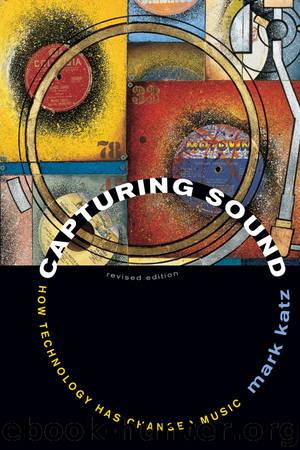
Capturing Sound by Mark Katz
Author:Mark Katz
Language: eng
Format: epub, mobi
Publisher: University of California Press
Published: 2010-04-07T04:00:00+00:00
A + B = MASHUP
The instrumental introduction is familiar to millions—a gently rising and falling guitar line accompanied by processed snare hits on the backbeat. It’s the opening of the 1983 song “Every Breath You Take” by the Police, and anyone who recognizes the music will expect the mellow voice of the Englishman known as Sting to enter a few bars later. But Sting is a no-show. Instead, a different mellow fellow enters: the American soul legend Ben E. King, and he’s singing his 1962 hit “Stand by Me.” To those who know both songs, the effect is jarring, and the first hearing might elicit a laugh at the incongruity of the Police backing up King. But listen a bit longer and it may dawn on you: this works. King’s voice nestles perfectly into the later song’s instrumental track, and the moods of the two match well. But just as you forget the oddity of it all, Sting sidles in. Answering King’s words, “stand by me,” he croons, “Oh can’t you see, you belong to me,” seamlessly picking up the older singer’s rhyme scheme. But then King returns, this time with his second verse and reinforcements in the form of his backup singers. Sting, however, is not to be denied and muscles back in with his bridge, “Since you’ve gone I’ve been lost without a trace,” putting a damper on King’s romantic vision of inseparable soul mates. Ultimately, love wins the day, and the stalker persona of the Police song is banished as King and his strings sweep in.
What I just described is neither “Every Breath You Take” nor “Stand by Me,” nor the result of an anomaly in the musical time-space continuum. It is, as can be heard on the companion Web site (audio/video file 24), its own musical entity, an example of what is called a mashup. (Mashups are also called bootlegs, especially in England, and for some who create these works it is the preferred term. To avoid confusion with the phenomenon of unauthorized concert recordings—also called bootlegs—I will use the term mashup.) In its most basic form, what practitioners call A+B, a mashup combines elements of two different songs, the vocals of one (A) with the instrumentals of another (B). Mashups exist in a variety of different forms, but as a general rule, they are works created by juxtaposing large, recognizable sections of two or more commercially released songs. Mashups, then, are a form of digital sampling, but differ from the other examples we’ve considered. Notjustmoreidlechatter manipulated a previously unreleased recording (and of speech, not music); “Praise You” used one long sample (of Camille Yarbrough’s “Take Yo’ Praise”), but set it within many smaller and unrecognizable samples; and “Fight the Power” added original vocals to its finely chopped instrumental track.
Mashups are also distinctive in that they are typically made not by self-identified composers or musicians, but by DJs, producers, or amateurs. Because their creators rarely seek or receive the authorization of the original artists or copyright
Download
This site does not store any files on its server. We only index and link to content provided by other sites. Please contact the content providers to delete copyright contents if any and email us, we'll remove relevant links or contents immediately.
The Goal (Off-Campus #4) by Elle Kennedy(13696)
Kathy Andrews Collection by Kathy Andrews(11858)
Diary of a Player by Brad Paisley(7602)
Assassin’s Fate by Robin Hobb(6235)
What Does This Button Do? by Bruce Dickinson(6214)
Big Little Lies by Liane Moriarty(5821)
Altered Sensations by David Pantalony(5113)
Pale Blue Dot by Carl Sagan(5021)
Sticky Fingers by Joe Hagan(4211)
The Death of the Heart by Elizabeth Bowen(3631)
The Heroin Diaries by Nikki Sixx(3555)
Confessions of a Video Vixen by Karrine Steffans(3317)
Beneath These Shadows by Meghan March(3315)
How Music Works by David Byrne(3286)
The Help by Kathryn Stockett(3156)
Computational Linguistics and Intelligent Text Processing: 20th International Conference, CICLing 2019 La Rochelle, France, April 7â13, 2019 Revised Selected Papers, Part I by Alexander Gelbukh(3126)
Jam by Jam (epub)(3102)
Harry Potter 4 - Harry Potter and The Goblet of Fire by J.K.Rowling(3086)
Strange Fascination: David Bowie: The Definitive Story by David Buckley(2877)
